Fish feed for aquaculture: a Norwegian conflict
Norway is the world’s largest producer of farmed Atlantic salmon, with sales of about 1.55M tons in 2024 from about 4,000 open sea cages. Norway is also a major producer and developer of fish feed for farmed Atlantic salmon. However, China is the world’s leading innovator of fish feed, with Chinese applicants filing 57% of related patent applications.
Challenges: increasing regulation & increasing cost
Environmental sustainability of farmed Atlantic salmon is a key driver for Norway’s Havbruksmelding (Aquaculture report) White Paper No. 24, which controls even further how production affects the environment, fish health and welfare. Feed production in Norway in 2022 was about 1.87 million tons of feed for grow-out. However, a change in feed composition to predominantly plant-based ingredients also requires importation of about 92% of the feed ingredients. Meanwhile, strong El Niño conditions have resulted in record-high fishmeal prices and affects soya and corn yields. Innovation to meet the environmental sustainability requirements demands investment and while innovation may also deliver future competitive advantage, the acceleration of aquaculture globally may overtake any Norwegian developments. Particularly, the rate of innovation of feed for Atlantic salmon by Chinese patent applicants may nullify efforts by Norwegian innovators to protect their own intellectual property while also limiting Norwegian access to global markets and further increasing feed costs.
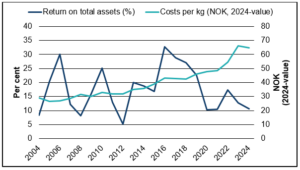
Figure 1: Average numbers for Norwegians companies with grow out production of Atlantic salmon and rainbow trout (Key figures from Norwegian Aquaculture industry 2025). Costs per kg produced fish are adjusted to 2024 for comparison. Feeding costs in 2024 amount to 40% of costs per kg.
Trends: Chinese innovation overtaking Norwegian intent
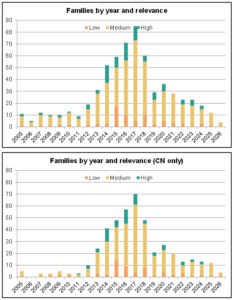
Figure 2: Increase in number of patent families relating to feed for Atlantic salmon, by year and relevance (FluidityIQ). Patent applications are typically published only 18 months after filing and data after 2025 are limited. The majority of patent application are filed by CN applicants. Generally, patent families are span either Asia or Europe & Americas – not both.
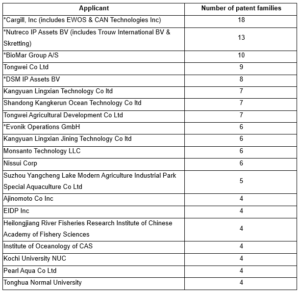
Table 1: Nine out of the top 20 applicants for patent applications relating to feed for Atlantic salmon are Chinese applicants, particularly private enterprises. In total, 454 out of 706 (i.e. 57.2%) patent families were filed by Chinese applicants. *Enterprises operating in Norway.
Drivers & Solutions: cost, sustainability & welfare
In 1990, feed for grow-out Atlantic salmon in Norway comprised about 90% marine ingredients, typically fishmeal and fish oil (Ytrestøyl et al, 2015). By 2022, feed had been innovated to reduce cost by reducing dependence on marine ingredients to just 22% or 28%, replaced by 73% plant-based ingredients, typically from soya, wheat, pea, corn, rapeseed and other oils, and about 0.4% of insects, microalgae, single cell protein and fermented products imported (Skavang and Strand, 2024; Salmon Farming Industry Handbook, 2025). Feed is formulated to replicate a natural nutritional profile, which would include smaller fish and crustaceans. However, the change in feed formulation to predominantly plant-based ingredients also resulted in a drop in omega-3 content of farmed Atlantic salmon. Innovations around novel sources of EPA and DHA, including algae and non-marine sources, seek to maintain high levels of omega-3s in feed while increasing feed sustainability.
Disease, including fish lice infestation, results in a current mortality rate of about 15% of farmed Atlantic salmon in Norway – with a target of just 5%. Some functional fish feeds have been shown to alter or marginally alter mucosal surfaces of Atlantic salmon, reducing sea lice attachment, for example. Additives include probiotics, prebiotics, immunostimulants, phytogenics, and omega-3 fatty acids (Onomu and Okuthe, 2024). However, R&D continues (Skugor and Wadsworth, 2024).
Winners, Losers & Disruptors: Norwegian inward focus vs Chinese outward reach
Traditionally, patent protection is a secondary consideration for many Norwegian innovators. Generally, Norwegian innovators of fish feed have limited patent protection to NO only, representing only the domestic market. However, patent protection is a primary consideration for the multi-national enterprises operating in Norway, leading to contentious patent proceedings. This is evidence of the commercial value of patent protection for fish feed.
STIM AS was awarded 36 million NOK in 2022 by the Borgarting Court of Appeal in Oslo, Norway. The Borgarting Court of Appeal found that BioMar Group A/S had infringed STIM’s SuperSmolt FeedOnly patents NO325534B1 and EP3197290B1. An appeal by BioMar Group A/S to the Supreme Court of Norway was rejected. In a twist of fate, EP3197290B1 was finally revoked ex tunc by the Board of Appeal in T 1879/21 (Fish feed/EUROPHARMA) of 13 October 2023, only after the Supreme Court of Norway dismissed the appeal: the award of 36 million NOK stood.
STIM AS continues attempts to obtain and maintain a granted patent originating from EP3197290B1. STIM AS is nevertheless defending against multiple third party observations and oppositions before the European Patent Office (EPO) for patent application and patents originating from EP3197290B1. Of the five divisional patents and patent applications: EP3398449B1 was finally revoked by the Board of Appeal in T 0815/23 (Method for smoltification in Salmonidae/STIM) of 20 February 2024; EP19162565.6 is deemed to be withdrawn; EP3808188B1 was opposed by Cargill, Incorporated with oral proceedings scheduled for 03 March 2027; EP3858149B1 was opposed by Cargill, Incorporated, BioMar Group A/S and Nutreco IP Assets BV with oral proceedings scheduled for 14 April 2027; and EP24217315.1 was submitted in December 2024, ten years after the original priority date.
BioMar Group A/S and Nutreco IP Assets BV (formerly NORSK HYDRO ASA) are not immune from contentions patent proceedings. EP1199947B1 was opposed by Ewos Innovation AS (now Cargill, Incorporated) and maintained in amended form while EP0574974B1 was opposed by Ewos Limited (now Cargill, Incorporated) and Nutreco Aquaculture Research Centre A/S (now Nutreco IP Assets BV) and revoked, respectively.
However, competition between these multi-national enterprises operating in Norway may distract from innovation. In contrast, Chinese enterprises particularly are highly active, matching filing of patent applications with their rates of innovation of fish feed. These innovations appear to include improvements for fish feeds for Atlantic salmon in Norway, particularly with respect to functional feeds and alternative ingredient sources.
The rapidly-expanding prior art resulting from filing of patent applications by Chinese applicants, for example, may prevent Norwegian innovators from securing patent protection for their inventions in Norway and abroad. Market exclusivity is lost.
Strategic Implications: innovators, investors, IP managers & leaders
Without adequate patent protection, Norwegian innovators are vulnerable to exploitation by competitors while third party patent protection will also limit their access to global markets. Market dominance in Norway will not translate to market opportunity abroad while the Norwegian market is not sufficiently large to support the increasingly-congested fish feed landscape: the multi-national enterprises operating in Norway typically also operate in Scotland, Canada and Chile.
Norwegian innovators of fish feeds must prioritise transforming their purposeful R&D into patent-protected assets. This is particularly important in view of the further regulatory demands in Norway and contentious competition. Investors should assess the potential exclusivity in markets of interest beyond Norway – and which markets are closed by Chinese patents, for example. IP managers must be vigilant of competing or adjacent technologies and associated patent protection while anticipating emerging technologies. And leaders must hold patent protection as a primary consideration in this growing market – the global Atlantic salmon market reached a production volume of 3.8 million tons in 2025 and is projected to reach 4.9 million tons by 2034, with China being the fastest growing consumer region.
What to watch next
Watch for: alternative ingredient sources to mitigate against supply shortages while meeting environmental sustainability targets; improved nutritional profiles while reducing fishmeal and/or fish oil; functional feeds; custom feed production on-site for particular grow-out stages; alternative (non-pellet) feed forms; AI innovations to reduce food waste, including rationing feed dispensing in fish farms using learned decision-making models to optimizing feeding times fish using shoal image analysis.
What to do next
By understanding Norwegian R&D in a global context, innovators of fish feed can position themselves ahead of both regulators and competitors. Get in touch.
Dehns is highly regarded for contentious matters, having also one of the largest EPO opposition and appeals practices in Europe and the largest in the UK. Get in touch with the Dispute Resolution Group.
References
- FluidityIQ
- Havbruksmelding (Aquaculture report) White Paper No.24: The Future of Aquaculture – Sustainable Growth and Food for the World. Meld. St. 24 (2024–2025)
- Key figures from Norwegian Aquaculture industry 2025
- Estimated farmed Atlantic salmon (2022)
- Salmon Market Size, Share, Trends and Forecast by Type, Species, End Product Type, Distribution Chanel, and Region, 2026-2034.
- Skavang PK and Strand AV (2024) Conceptualization of the Norwegian feed system of farmed Atlantic salmon.
- A ‘super’ El Niño has the power to devastate fishing – and leave seals and sea lions starving (2026)
- Trine Ytrestøyl, Turid Synnøve Aas, Torbjørn Åsgård, Utilisation of feed resources in production of Atlantic salmon (Salmo salar) in Norway, Aquaculture, Volume 448, 2015, Pages 365-374
- Salmon Farming Industry Handbook (2025)
- Stank Skugor and Simon L. Wadsworth, Functional feeds and sea lice control, Sea Lice Biology and Control, pp. 471-492, 27 September 2024.
- Onomu, A. J., & Okuthe, G. E. (2024). The Role of Functional Feed Additives in Enhancing Aquaculture Sustainability. Fishes, 9(5), 167.