Critical and strategic raw materials in Norway: demand for continuous innovation
Norway’s natural resources and mineral & ore processing capabilities are quasi-unique in Europe, providing critical and strategic raw materials essential for manufacturing and innovation in computing, defence (including dual-use technologies), space, transport and renewable energy. Security of supply and strategic autonomy of these materials are prioritized by government policy, ensuring supply chain and economic resilience in a geopolitically volatile and distorted global market.
However, increasing global commodity competition and government regulation demand Norwegian companies to innovate continuously.
Challenges: competition & regulation
Mineral and ore extraction are global. However, processing of imported minerals & ores is highly localized, particularly in China. For example, China dominates global processing of inter alia: graphite; rare earth elements (REEs); cobalt; and lithium. Future strategic competition is likely to be less about who extracts the minerals & ores and more about who controls the processing (including material quality and capacity) and the supply chains. Particularly, global supply chains are increasingly considered as vulnerabilities while global commodity competition may distort by state-sponsored policies.
The new Norwegian Minerals Act introduces reforms to accelerate and modernize mineral & ore processing in Norway. However, these reforms are balanced by strengthened social and environmental sustainability obligations, which are may be viewed as disadvantages when competing globally.
Trends: strategic importance & unmatched IP
Norway has unique European natural resources, including: natural graphite; nepheline syenite; and titanium-bearing minerals. More importantly, Norway has major mineral & ore processing capabilities for: aluminium; silicon; ferrosilicon; nickel; cobalt; manganese; zinc; REEs; and synthetic graphite. These mineral & ore processing capabilities are primarily enabled by renewable energy (especially hydroelectric) and facilitated by deep-water, ice-free ports in the Norwegian fjords for import of minerals & ores.
Figure 1: Companies in Norway providing mineral & ore processing capabilities for selected materials.
Figure 2: Norway’s mineral & ore processing capabilities for selected materials, comparing share of global production, share of European production and global value of the materials (bubble size in billion NOK e.g. Al about 2,500 billion NOK; Co about 20 billion NOK).
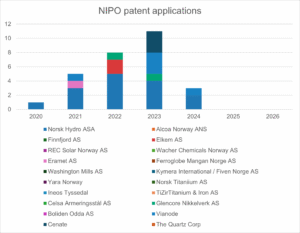
Figure 3: Norwegian priority-founding patent applications filed at Norwegian Industrial Property Office (NIPO) by companies in Norway providing mineral & ore processing capabilities. Patent applications are typically published only 18 months after filing and data after 2025 is currently not available. A total of only 28 priority-founding Norwegian patent applications were filed from 2020 to 2024. Most of these companies did not file any priority-founding Norwegian patent applications from 2020 to 2024. Yara Norway appears to first file at EPO. In contrast, from 2020 to 2024, more than 80,000 patent application were filed worldwide for mining and about 21,000 patent applications were filed worldwide for metallurgy.
Drivers & Solutions: priorities for innovation & IP
Norway cannot compete on price alone.
In contrast, Norway must prioritise higher-value, low-carbon, traceable, sustainable materials integrated into allied supply chains to meet security of supply and regulatory requirements while enhancing global competitiveness.
Mineral & ore processing capabilities may be transformed to low- or lower-carbon, by:
low-carbon silicon production;
bio-carbon reductants replacing fossil carbon;
electrification of processing;
carbon capture in process industries;
waste heat recovery; and/or
hydrogen-based metallurgical processes.
Circular-economy innovation highlights resource efficiency, reuse, recycling & reprocessing, including:
by-product recovery:
waste valorisation; and/or
critical metal extraction from residues.
Downstream product innovation is necessary for Norway to shift from being primarily a raw-material exporter, for example:
focusing on battery-grade graphite, coated anode materials & battery components rather than graphite;
capturing added value of silicon in battery materials, solar products & silicon compounds rather than silicon;
providing titanium sponges & advanced products rather than rutile & ilmenite; and/or
supplying separated REE oxides, metals & magnets rather than REE concentrates.
Winners, Losers & Disruptors: innovating purposefully & protecting IP
All the companies in Norway providing mineral & ore processing capabilities have direct global competitors – together with downstream and upstream competitors.
For example, Norsk Hydro’s primary direct global competitors and low-carbon peers include Emirates Global Aluminium (EGA), Alcoa, and UC Rusal. In addition, Rio Tinto and Alcoa compete upstream while Constellium and Novelis (Hindalco) compete downstream, with high value-added aluminium products. However, China Hongqiao and Chinalco produce more than half of all global primary aluminum, suppressing pricing and complicating premium green approaches.
Strengthening its position in low carbon aluminium, Hydro Havrand, a Norsk Hydro fully owned company, is developing its own green hydrogen facilities and providing expertise to enable customers to transition to renewable energy. Separately, Norsk Hydro’s most recent PCT patent application PCT/EP2025/061388, published as WO 2025/224325 A1 and claiming priority from NO20240398, is directed towards a high-strength Al-Mg-Si alloy and extruded profile especially suitable for use in vehicles – moving downstream to high value-added aluminium products.
That is, Norsk Hydro is prioritising higher-value, low-carbon aluminium integrated into its allied supply chains. However, in mature and congested IP landscapes such as for aluminium alloys, IP intensity & density are required to maintain competitive distance.
Strategic Implications: innovators, investors, IP managers & leaders
Without adequate patent protection, innovators are vulnerable to exploitation by global competitors while third party patent protection will also limit their access to global markets. This is particularly relevant in mature and congested IP landscapes, in which innovation is typically incremental. However, complying with national regulations is also a requirement.
Norwegian innovators must prioritise higher-value, low-carbon, traceable, sustainable materials integrated into allied supply chains to meet security of supply and regulatory requirements while enhancing global competitiveness. Investors should assess the potential exclusivity in markets of interest – and which supply chains are geopolitically vulnerable. IP managers must be vigilant of competing or adjacent upstream & downstream technologies as well as of direct competitors. And leaders must hold patent protection as a primary consideration for critical and strategic raw materials, given the geographical distribution of mineral & ore processing capabilities and term of protection.
What to watch next
Watch for: transformation to low- or lower-carbon; circular-economy innovation; downstream product innovation.
What to do next
By understanding mineral & ore processing capabilities in supply chain contexts, innovators can enhance commercial value and robustness to geopolitical volatility. Get in touch.
References
- PROSESS21 Critical and Strategic Raw Materials in Norway: Positions and Potentials (19 June 2026)
- Norwegian Minerals Act & regulation (entered into force 01 July 2026):
https://www.regjeringen.no/contentassets/9a26c63cb36c42be83ae76e8589329b6/no/pdfs/nou202220220008000dddpdfs.pdf
https://www.regjeringen.no/contentassets/4c0cf73e24974303963746513cd08667/no/pdfs/prp202420250071000dddpdfs.pdf
https://www.stortinget.no/globalassets/pdf/innstillinger/stortinget/2024-2025/inns-202425-521l.pdf
https://www.regjeringen.no/contentassets/ea38935a4b8b42b5a01c8e9d77a28f02/horingsnotat-forslag-til-forskrift-til-lov-om-mineralvirksomhet-og-forvaltning-av-mineralressurser.pdf - NGU Report 2024.023 Overview of critical metals and minerals in Norway
- Overview of the Norwegian metallurgical industry – Part 1
Overview of the Norwegian metallurgical industry – Part 2
Overview of the Norwegian metallurgical industry – Part 3 - EPO Statistics & Trend Centre