Today, on 12 August 2026, much of western Europe and some of North America will experience at least a partial solar eclipse as the Moon transits between the Sun and the Earth.
Directly observing solar eclipses is dangerous for humans. Our retinas do not have pain receptors, meaning that we have no perception that the Sun is damaging our eyes as we look at it, particularly when its brightness is reduced during an eclipse.
Whilst solar eclipses are relatively common globally, in the sense that they occur several times a year (a total eclipse happens every 18 months or so), observing a solar eclipse can be a challenge for humans given that most of the Earth’s surface is covered by water. Nevertheless, humans throughout history have observed solar eclipses and several clever innovations have arisen to achieve this aim more safely. Starting in the eleventh century, Al-Haytham developed the first camera obscura (pinhole camera) and used this to observe solar eclipses.
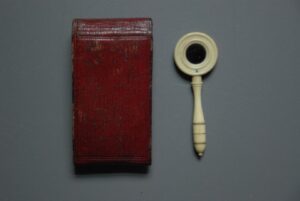
The invention of the camera obscura (pinhole camera) was the first offering of a way to safely observe the phenomenon happening, but it is rather indirect. The camera obscura may have been invented in the eleventh century by Middle Eastern physicist Ibn al-Haytham, or as early as the fourth century by Aristotle. Direct but protected observation of a solar eclipse (i.e. with one’s eye) took place in 1706, when Louis XIV of France used smoked glass to view an eclipse. This basic form of dimming allowed people to witness the Sun being covered by the moon; however, it was by no means safe. Smoked glass does not often absorb harmful UV and infrared radiation that damage the retina.
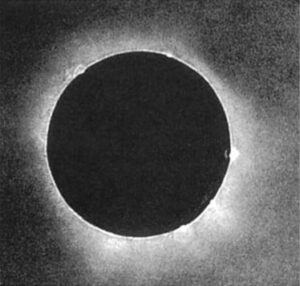
Smoked glass was not substantially developed upon until 1851, when Julius Berkowski became the first person to successfully photograph the solar corona during a solar eclipse. Compared to the couple of millennia, this ushered in a flurry of innovation in eclipse observation.
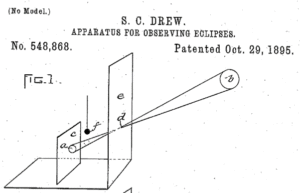
In 1894, we find US 548 868 A, a United States patent application directed to observing characteristics of the corona of the Sun. Stemming from a widespread desire to understand the corona, the disclosed apparatus provided a means for eclipsing the Sun consistently, and at any time, in order to observe and study the corona’s composition.
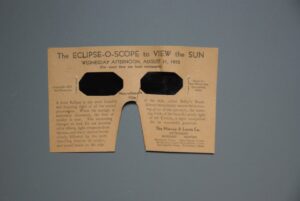
A mass-market innovation was the 1932 introduction of Eclipse-O-Scope, a “protective film” placed in carboard and shaped as glasses for protected viewing of a solar eclipse. Whilst approved by the American Astronomical Society at the time, these glasses did not fully solve the problem of protecting the retina. Eclipse-O-Scope glasses appear to use very dark photographic film to dim the Sun’s radiation to a suitable level. It is unlikely that they would have offered suitable protection against the Sun’s UV and infrared radiation.
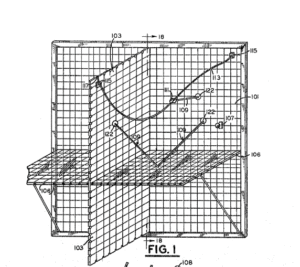
With increasing education levels in the latter half of the twentieth century, came increasing innovation in teaching about eclipses. 1968 saw Canadian patent application CA 776 372 A filed. This patent application relates to a three-dimensional grid used to demonstrate scientific concepts, including the shadow of a solar eclipse.
Public interest in eclipses appears to grow ever stronger, and eclipse safety ever higher. Even eclipse glasses from as recent as the late 1990s and early 2000s are not generally considered safe for using today. Modern eclipse glasses typically use a polymer film with a metallic reflective layer. The polymer film is used to darken the scene so that it is possible to look directly at the sun, using the same principle as Eclipse-O-Glass. Typically, the polymer film used is Mylar, a PET based film, that is infused with carbon black particles to darken the scene.
However, the important safety innovation in today’s eclipse-viewing glasses is the metallic reflective layer which reflects harmful UV and infrared radiation away from the retina. This arrangement results in a set of glasses that are both dim enough to allow comfortable viewing of the solar eclipse and protected enough to ensure that the retina is not damaged. The metallic layer is often aluminium or nickel and chromium, which results in the sun appearing orange through the lenses.
For safety reasons, there are now strict rules for producing solar eclipse glasses. Solar eclipse glasses must comply with international safety standard ISO 12312-2, which specifies the minimum amount of filtration and the material integrity of the lenses. Double-check yours before the eclipse today!