AI in Aquaculture: a Norwegian paradox
Norway is the world’s largest producer of farmed Atlantic salmon and a major developer of AI for aquaculture. However, China is the world’s leading innovator of AI in aquaculture, with Chinese patent applicants filing 75% of related patent applications.
Challenges: increasing regulation & increasing competition
Innovation is essential to achieve the objectives set out in Norway’s Havbruksmelding (Aquaculture report) White Paper No. 24. Aquaculture in Norway is already subject to the most stringent of regulations. This White Paper controls even further how production affects the environment, fish health and welfare. For example, fish lice levels are to be managed and mitigated more effectively while fish mortality levels are to be lowered to below 5%. Innovation demands investment and while innovation may also deliver future competitive advantage, the acceleration of aquaculture globally may overtake any Norwegian developments. Particularly, the rate of innovation of AI in aquaculture by Chinese patent applicants may nullify efforts by Norwegian innovators to protect their own intellectual property while also limiting Norwegian access to global markets.
Trends: Chinese innovation overtaking Norwegian intent
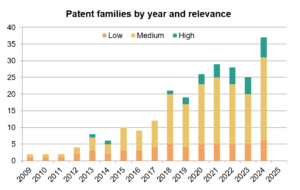
Figure 1: Increase in number of patent families relating to AI in aquaculture, by year and relevance (FluidityIQ). Patent applications are typically published only 18 months after filing and data after 2025 is currently not available. This accelerating trend is expected to continue to increase, both in number and relevance. Generally, patent families are span either Asia or Europe & Americas – not both. This is consistent with technology deployment models for AI in aquaculture (Williamson, McAuliffe & Moulange, 2026).
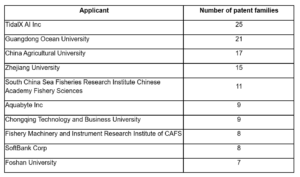
Table 1: Six out of the top 10 (and 38 out of the top 50) patent applicants for patent applications relating to AI in aquaculture are Chinese applicants, particularly universities. In total, 560 out of 742 (i.e. 75.5%) patent families were filed by Chinese applicants. This contrasts with the global locations of companies with AI-enabled products for use in aquaculture, which are almost exclusively outside of China (Williamson, McAuliffe, McKay, 2025). TidalX AI Inc and Aquabyte Inc operate in or from Norway.
Drivers & Solutions: feed, welfare, environment & labour
AI is transforming aquaculture (Williamson, McAuliffe, McKay, 2025; Haque and Jufaili, 2026). Why and how?
Feed accounts for about 50% of operational costs for farmed Atlantic salmon. AI innovations reduce food waste, including rationing feed dispensing in fish farms using learned decision-making models to optimizing feeding times fish using shoal image analysis. AI innovations also predict and monitor fish growth, including modelling of the fish farms to biomass estimation from images of individual fish.
Disease, including fish lice infestation, and injury result in a current mortality rate of about 15% of farmed Atlantic salmon in Norway – with a target of just 5%. AI innovations identify disease and injury, including detecting wounds, deformities and fish lice from images of individual fish to assessing stress or injury using shoal image analysis. AI innovations also delouse fish using lasers and manage oxygenation levels.
Food waste, fish waste and oxygen consumption affect the environment, including the local environment of Recirculating Aquaculture Systems (RAS). AI innovations control water quality using sensor inputs and three-dimensional prediction models, that account for weather and/or tidal patterns. AI innovations also reduce food waste.
Reducing labour availability and increasing labour costs are limiting scaling and profitability of fish farming. AI innovations reduce labour demand, including optimised feeding, automated assessment of individual fish & fish shoals using image analysis and minimised manual intervention using autonomous cleaning robots.
Winners, Losers & Disruptors: Norwegian purpose vs Chinese scale & speed
TidalX AI Inc and Aquabyte Inc both combine cameras, sensors and AI for real-time biomass estimation, sea lice detection, fish welfare monitoring, and autonomous feeding. However, both TidalX AI Inc and Aquabyte Inc are outliers amongst Norwegian innovators. Traditionally, patent protection is a secondary consideration for many Norwegian innovators. Nevertheless, Norwegian innovators, including AKVA Group, Biosort AS, CageEye AS, Createview AS, Manolin Inc, OptoScale AS and Stingray Marine Solutions AS, are purposefully researching, developing and deploying AI in aquaculture.
In contrast, Chinese universities particularly are highly active, matching filing of patent applications with their rates of innovation of AI in aquaculture.
The rapidly-expanding prior art resulting from filing of patent applications by Chinese applicants, for example, may prevent Norwegian innovators from securing patent protection for their inventions in Norway and abroad. Market exclusivity is lost.
Strategic Implications: innovators, investors, IP managers & leaders
Without adequate patent protection, Norwegian innovators are vulnerable to exploitation by competitors while third party patent protection will also limit their access to global markets. Market dominance in Norway will not translate to market opportunity abroad.
Norwegian innovators of AI in aquaculture must prioritise transforming their purposeful R&D into patent-protected assets. Investors should assess the potential exclusivity in markets of interest – and which markets are closed. IP managers must be vigilant of competing or adjacent technologies and associated patent protection. And leaders must hold patent protection as a primary consideration in this rapidly evolving technical field: AI is ubiquitous and enabling.
What to watch next
Patent applications for AI in aquaculture will follow the accelerating trend for AI applications generally: AI is not the rate-limiting step.
Watch for: continuous monitoring and preventative treatment of individual fish; optimized feeding accounting for fish and environmental variables; and autonomous Recirculating Aquaculture Systems.
What to do next
By understanding Norwegian R&D in a global context, innovators of AI in aquaculture can position themselves ahead of both regulators and competitors. Get in touch.
References
- Syed Ariful Haque and Saud M. Al Jufaili. 2026. Applications of Artificial Intelligence in Fisheries: From Data to Decisions. Big Data Cogn. Comput. 2026, 10(1), 19;
- FluidityIQ
- Havbruksmelding (Aquaculture report) White Paper No.24: The Future of Aquaculture – Sustainable Growth and Food for the World. Meld. St. 24 (2024–2025)
- Williamson, S., McAuliffe, W., & McKay, H. 2025. How AI is affecting farmed aquatic animals: Part 1: Innovation. Rethink Priorities.
- Williamson, S., McAuliffe, W., & Moulange, H. 2026. How AI is affecting farmed aquatic animals: Part 2: Deployment. Rethink Priorities.
- Estimated farmed Atlantic salmon (2022)